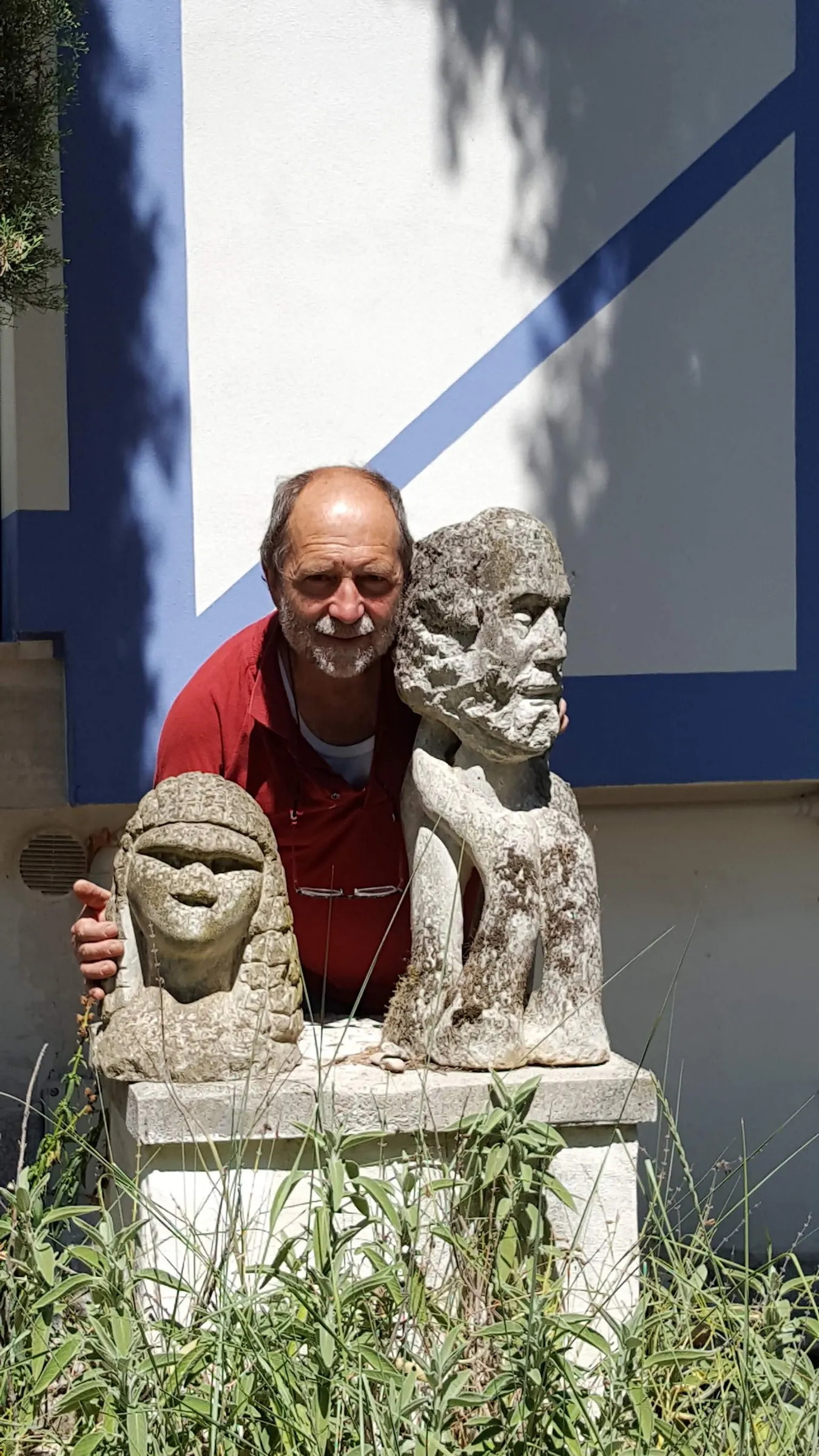
Pasquale Liberatore was born in San Demetrio ne' Vestini, in the province of L'Aquila, in 1950. He attended the Art Institute of L'Aquila and continued his training at the Academy of Fine Arts of L'Aquila, where he graduated. In 1977, at just twenty-seven, he was appointed professor of Technology and Use of Marble and Stone in the School of Sculpture of the same Academy.
Pasquale Liberatore's inner imagery takes shape from the mountains and woods of his native Abruzzo. From his very first works in the 1970s, in which he reproduced gigantic seeds in marble and stone, he showed a deep concern for nature, developing an intense engagement with matter and turning his attention to archetypal images.
The 1980s
In 1982 he took part in the group exhibition "Doppio versante", the third review of figurative art in Acquaviva Picena. The following year he showed at "Intimità dell'indagine" in the Civic Gallery of Modern Art at Palazzo dei Diamanti in Ferrara, at "L'immagine diversa" within the Premio Michetti in Francavilla al Mare, and at "Psicanalisi ed arte, psicanalisi ed estetica" at the Centro Servizi Culturali in Pescara.
In the mid-1980s, alongside sculptural forms ranging from free-standing pieces to wall reliefs, he explored the insertion into stone of elements derived from technological materials (paint, lead, iron, rubber, fibreglass, spray) while always referring to images from a remote past. In 1986 he took part in "Ricognizione Sud" within the 11th Rome Quadriennale and in "Forme nel verde. Twelve sculptors between nature and geometry" in San Quirico d'Orcia. In 1987 he showed at "Alternative Attuali – Abruzzo 87" at the Forte Spagnolo in L'Aquila and won first prize at the 38th Premio Michetti in Francavilla al Mare; the following year he took part in "Alternative Attuali '88. Painting and music" at the Convitto Nazionale.
At the end of the 1980s he turned his research to wood and other materials, treated structurally and as signs through cuts and burning. In 1989 he took part in the travelling exhibition "La provincia e l'Impero" at the Palazzo Marchesale in Trentola Ducenta, the Cloister of San Giovanni in Orvieto and Palazzo Colonna in Paliano. In 1990 he showed at "Intercity Uno" at the Fondazione Bevilacqua La Masa in Venice, at "Arte Roma '90" and in the travelling group show "Il lusso della pausa" in Florence, Rome and the Cloister of Santa Maria di Collemaggio in L'Aquila.
Stone as a document
In the 1990s he opened up to the most varied experiences, both in terms of research into materials and in pursuit of a heightened expressiveness. He starts from the premise that stone, if properly analysed and understood, is a geological, historical and anthropological document: the key to revealing how humans and living beings behave within their environment. He understands art as a creative act applied to the practice of seeing, investigating and knowing: it gives us the ability to shape human existence, becoming intuitive, contemplative and spiritual, an irreplaceable tool for revealing the bond between people, the landscapes of the world and matter itself.
He has made monumental works for public spaces: from the international granite sculpture symposium in Buddusò (1985) to the "Campo del Sole" at Tuoro sul Trasimeno (1986), from "La pietra svelata" in Poggio Picenze (1991) to "Ten days in stone" in Lettomanoppello (1997), and on to "Scultura Viva" in San Benedetto del Tronto and the International Stone Sculpture Symposium of Fanano (1999). He has organised sculptural performances aimed at rediscovering the age-old bond between people and stone: "The soul of the stone" in Lettomanoppello (1997), "Ring around the mountain" in Sant'Eusanio Forconese (1997), "Relations with the stone" in Pianola (1998), "The city and memory", a sculpture-fountain for Bugnara (1999), "Outside inside the body of the stone" at Palazzo Margherita in L'Aquila (2000), "Microcosm of Saint Michael" in Villa Sant'Angelo (2004), "Sora Acqua Sora Pietra", an environmental project on a spring in Lettomanoppello, and "Meditative path" in Casalbordino (2007).
Grafts between humans and nature
In the 2000s he made monumental works centred on the idea of grafts between humans and nature, turning stone into bulb, seed, meteor: bodies whose organic nature collides with other materials, to continue together a journey outside time and space. He increased his output as a painter, considering a "beautiful painting" that tends to incorporate "the dirty and the ugly", the residues and dross of everyday life, which "flutter" across the canvas, dragged and layered by the brush amid slides of colour. Some of his paintings were shown in Istanbul, at Marmara University Fine Arts and the Gallery of Kadıköy Municipality, for the "ArteAccademia" project (December 2007 – January 2008).
Since 2010 he has produced large-scale works: "Sprout", the monument to the victims of the 2009 earthquake in Villa Sant'Angelo (2010); "Seed" for "Ten days in stone" in Lettomanoppello (2013); "Dew condenser", an environmental installation for the Water Museum in Isola del Gran Sasso (2015); "Exodus" in San Benedetto del Tronto and "For Giorgia" in San Nicandro (2015).
A solitary and tenacious artist
Pasquale Liberatore is a solitary and tenacious artist who does not let himself be swayed by artistic trends. For many years he has pursued a sculptural research based above all on trying to understand nature, and in particular on observing the closed, embryonic forms that generate and enclose life: seeds, tubers, sprouts. He transforms these natural elements in order to grasp their purpose and their evolutionary meaning. In the act of translating them into sculpture, and in the awakening of the senses that follows, he seeks an existential awareness through analogical references, looking for connections with humankind and answers to contemporary problems.
In his most recent works he follows the path of visual anthropology, and over the years he has campaigned for the defence of the land and the safeguarding of nature. His research in sculpture and painting has never stopped: today it turns to the mountains as sacred bodies to be respected, and to stone, shaped and understood by the sculptor as the bones of planet Earth.